Thursday, August 11, 2016

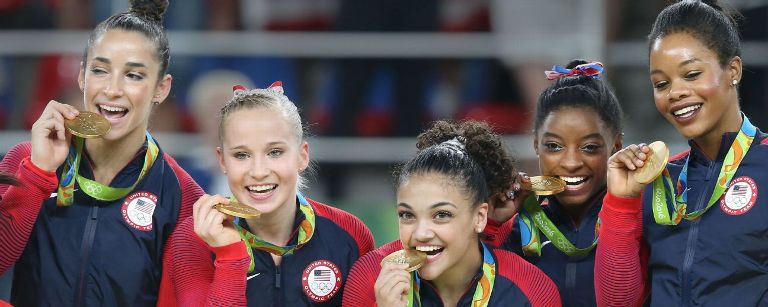
The diversity of the 2016 US women's gymnastics team

How is this for an incredible picture?


I am almost at a loss for words.  When I first saw that picture, a million questions crossed my mind.  How did we get here?  How did US gymnastics put together an elite team of gymnasts that look like a microcosm of our society?  Could we replicate this success in other contexts? If the US gymnastics team could go this far over a generation, maybe there is hope for us?

It is easy to look at this picture differently, as a critique of efforts to diversify our society.  In other words, one can look at this picture and conclude that diversity efforts are unnecessary in a world where individual merit and hard work are rewarded. Chief Justice Roberts offered a variant of this argument in his opinion in Parents Involved: "The way to stop discrimination on the basis of race is to stop discriminating on the basis of race."  And once we stop, all will be well.

I don't buy it, and I don't think the Chief Justice buys it either.  A world where merit is rewarded accordingly, and where hard work takes you where you deserve to go, is not a world I recognize. It is the great American story, to be sure, but it is not reality.  Spend one moment in a hiring committee of your choice and you will know exactly what I mean.  Merit and desert are amorphous catch phrases devoid of any useful meaning.  They are conclusions, not arguments.

Which is why the US gymnastics team blows my mind.  It is one thing to put ten runners at the starting line if we are trying to decide who is the fastest of them all (think here, incidentally, about the Iliad, and particularly Achilles' struggle with merit and desert throughout the poem, and especially during the Games).  But gymnastics, where judges stand on the sidelines and award scores to individual competitors on the basis of what they see and understand, is clearly not racing.  This is a world where conventions and traditions must be followed.  This is also a world where athletes of color have been largely absent.

And that is the point.  This team is normalizing race within a sphere where race has almost served as a barrier of entry, no different from playing quarterback or running back.  And for that, I am thankful, and hopeful.  America's darlings are White, and Black, and Latina.  And so could be anyone else, whether Asian or American Indian, Muslim or Jew.

Indeed, my mind is blown.

Indeed.

Wednesday, August 10, 2016

A word on Justice Kennedy's "surprising" turn to the left

A few weeks ago, the US Supreme Court upheld the University of Texas' affirmative action plan in Fisher v. Texas.  The big story of the case was Justice Kennedy's apparent switch on questions of race.  How in the world does a justice who refers to the use of race by the state as a "corrosive category," and who argues that “[p]referment by race, when resorted to by the State, can be the most divisive of all policies, containing within it the potential to destroy confidence in the Constitution and in the idea of equality," vote to uphold an affirmative action plan?

This was the leading narrative in the wake of Fisher.  Justice Kennedy's opinion was "stunning," "surprising," even "shocking." But that's not quite right.  

Monday, August 1, 2016

More on North Carolina NAACP v. McCrory, the North Carolina Voter ID Case

Last week, a 3-judge court of the Fourth Circuit Court of Appeals issued a unanimous opinion striking down North Carolina's voter identification laws.  Guy offered a terrific discussion of the opinion here, and I don't have much to add to his analysis.  It is dead on.  I want to focus instead on the lessons of the case about judicial behavior, race, and constitutional interpretation.

Friday, July 29, 2016

Fourth Circuit Court of Appeals Strikes Down North Carolina Voting Law

I have a few thoughts on the Fourth Circuit's decision today, which struck down NC's omnibus voting rights law.  North Carolina's law required voters to show a a photo ID when voting at the polls; it eliminated same date registration; it reduced the number of early voting days; it eliminated pre-registration, among its more notorious accomplishments. The Court concluded that the State enacted the law with a racially discriminatory intent.  After finding discriminatory intent, the Court shifted the burden to the State to show that the law would have been enacted in the absence of a racially discriminatory purpose.  The Court concluded that NC could not meet that burden and it struck down the law as unconstitutional. 

First, the most compelling part of the Fourth Circuit's opinion is its argument that the legislature requested racial data on how voters used various election procedures; after receiving the data the legislature decided which voting procedures they were going to change; the voting procedures that they changed "target[ed] African Americans with almost surgical precision." For example, the legislature requested racial data on voter ID and excluded many of the types of photo IDs used by African Americans but permitted the types of photo IDs used by whites.  The legislature requested racial data on early voting.   The data revealed that African Americans disproportionately used the first seven days of early voting.  The Court noted that "[a]fter receipt of this racial data, the General Assembly amended the bill to eliminate the first week of early voting, shortening the total early voting period from seventeen to ten days." This was also true for same-day registration and provisional voting.  For the race and law nerds, the Fourth Circuit's analysis here is similar to the Supreme Court's analysis in Gomillion v. Lightfoot: the way that the voting restrictions affected African Americans is only explainable if African Americans were being intentionally targeted.  The Fourth Circuit concluded: "In sum, relying on this racial data, the General Assembly enacted legislation restricting all--and only--practices disproportionately used by African Americans.  When juxtaposed against the unpersuasive non-racial explanations the State proffered for the specific choices  it made . . . we cannot ignore the choices the General assembly made with this data in hand."

Second, the Fourth Circuit also made clear that partisan discrimination is not a compelling defense or justification to a charge of vote denial or franchise restriction.  But as importantly, the Court made an important link between partisan discrimination and racial discrimination.  The Court said, "intentionally targeting a particular race's access to the franchise because its members vote for a particular party" is racial discrimination.  See also pages 40 and 56 where the Court is explicit that "targeting voters who, based on race, were unlikely to vote for the majority party[,] [e]ven if done for partisan ends, . . . constitute[] racial discrimination." This line of reasoning essentially eliminates the "it was not race it was party" defense.  This is very interesting and a potentially powerful development.

Third, this opinion is a repudiation of Shelby County.  The opinion is clear that just as "African American registration and turnout rates had finally reached near-parity with white registration" and that "African Americans were poised to act as a major force," the State tried to curtail the voting power of African Americans. The opinion strongly intimated that the State was able to do so only because of the Supreme Court's decision in Shelby County.  On page 32 of the opinion the Fourth Circuit take's Shelby County head-on and essentially refutes Shelby's claim that "history did not end in 1965."  From the perspective of the Fourth Circuit, NC has not stopped discriminating ("state officials continued in their efforts to restrict or dilute African American voting strength well after 1980 and up to the present day"). Moreover, they would have been more successful in their discriminatory attempts were it not for "the robust precautions of section 5 and suits by private plaintiffs under section 2 of the Voting Rights Act [which] prevented those efforts from succeeding." Shelby County removed that protection.  The Fourth Circuit restored it. 

Fourth and relatedly, the Court's analysis essentially shifts the burden on to the state to prove that it was not discriminating where there is a strong discriminatory impact.  The Court is explicit about its burden-shifting framework, but says it applies only where there is discriminatory intent.  But discriminatory intent here is basically shown with discriminatory impact. Yes, the Court uses NC's history of discrimination and some other factors to infer intent.  But the biggest factor is discriminatory impact.  If other courts follow this opinion, plaintiffs can get the burden shifted to the state where there is a strong discriminatory impact and a history of discrimination.  This process goes a long way toward restoring section 5's burden-shifting framework.

Fifth, I don't think this opinion would have been written the same way and I'm not sure if it would have come out the same way if Justice Scalia were still on the Court.  It is easily conceivable that this panel, given its makeup, might have struck down the most vulnerable provisions of the law but maybe not the whole thing.  Moreover, they would probably have done a disparate impact analysis instead of a discriminatory intent analysis.  The discriminatory intent finding allowed the Fourth Circuit to avoid sending the case (specifically the voter ID portion of the case) back down to the district court, which had upheld the law in its entirety. 

With a 4-4 split on contentious issues, Court of Appeals are functionally courts of last resort.  NC can cry as much as it wants, but its omnibus law is now dead.  It will be buried after the appeals have been exhausted.

Lastly, big win for the plaintiffs.  Total victory.

Fourth Circuit Court of Appeals Strikes Down North Carolina Voting Law

I have a few thoughts on the Fourth Circuit's decision today, which struck down NC's omnibus voting rights law.  North Carolina's law required voters to show a a photo ID when voting at the polls; it eliminated same date registration; it reduced the number of early voting days; it eliminated pre-registration, among its more notorious accomplishments. The Court concluded that the State enacted the law with a racially discriminatory intent.  After finding discriminatory intent, the Court shifted the burden to the State to show that the law would have been enacted in the absence of a racially discriminatory purpose.  The Court concluded that NC could not meet that burden and it struck down the law as unconstitutional. 

First, the most compelling part of the Fourth Circuit's opinion is its argument that the legislature requested racial data on how voters used various election procedures; after receiving the data the legislature decided which voting procedures they were going to change; the voting procedures that they changed "target[ed] African Americans with almost surgical precision." For example, the legislature requested racial data on voter ID and excluded many of the types of photo IDs used by African Americans but permitted the types of photo IDs used by whites.  The legislature requested racial data on early voting.   The data revealed that African Americans disproportionately used the first seven days of early voting.  The Court noted that "[a]fter receipt of this racial data, the General Assembly amended the bill to eliminate the first week of early voting, shortening the total early voting period from seventeen to ten days." This was also true for same-day registration and provisional voting.  For the race and law nerds, the Fourth Circuit's analysis here is similar to the Supreme Court's analysis in Gomillion v. Lightfoot: the way that the voting restrictions affected African Americans is only explainable if African Americans were being intentionally targeted.  The Fourth Circuit concluded: "In sum, relying on this racial data, the General Assembly enacted legislation restricting all--and only--practices disproportionately used by African Americans.  When juxtaposed against the unpersuasive non-racial explanations the State proffered for the specific choices  it made . . . we cannot ignore the choices the General assembly made with this data in hand."

Second, the Fourth Circuit also made clear that partisan discrimination is not a compelling defense or justification to a charge of vote denial or franchise restriction.  But as importantly, the Court made an important link between partisan discrimination and racial discrimination.  The Court said, "intentionally targeting a particular race's access to the franchise because its members vote for a particular party" is racial discrimination.  See also pages 40 and 56 where the Court is explicit that "targeting voters who, based on race, were unlikely to vote for the majority party[,] [e]ven if done for partisan ends, . . . constitute[] racial discrimination." This line of reasoning essentially eliminates the "it was not race it was party" defense.  This is very interesting and a potentially powerful development.

Third, this opinion is a repudiation of Shelby County.  The opinion is clear that just as "African American registration and turnout rates had finally reached near-parity with white registration" and that "African Americans were poised to act as a major force," the State tried to curtail the voting power of African Americans. The opinion strongly intimated that the State was able to do so only because of the Supreme Court's decision in Shelby County.  On page 32 of the opinion the Fourth Circuit take's Shelby County head-on and essentially refutes Shelby's claim that "history did not end in 1965."  From the perspective of the Fourth Circuit, NC has not stopped discriminating ("state officials continued in their efforts to restrict or dilute African American voting strength well after 1980 and up to the present day"). Moreover, they would have been more successful in their discriminatory attempts were it not for "the robust precautions of section 5 and suits by private plaintiffs under section 2 of the Voting Rights Act [which] prevented those efforts from succeeding." Shelby County removed that protection.  The Fourth Circuit restored it. 

Fourth and relatedly, the Court's analysis essentially shifts the burden on to the state to prove that it was not discriminating where there is a strong discriminatory impact.  The Court is explicit about its burden-shifting framework, but says it applies only where there is discriminatory intent.  But discriminatory intent here is basically shown with discriminatory impact. Yes, the Court uses NC's history of discrimination and some other factors to infer intent.  But the biggest factor is discriminatory impact.  If other courts follow this opinion, plaintiffs can get the burden shifted to the state where there is a strong discriminatory impact and a history of discrimination.  This process goes a long way toward restoring section 5's burden-shifting framework.

Fifth, I don't think this opinion would have been written the same way and I'm not sure if it would have come out the same way if Justice Scalia were still on the Court.  It is easily conceivable that this panel, given its makeup, might have struck down the most vulnerable provisions of the law but maybe not the whole thing.  Moreover, they would probably have done a disparate impact analysis instead of a discriminatory intent analysis.  The discriminatory intent finding allowed the Fourth Circuit to avoid sending the case (specifically the voter ID portion of the case) back down to the district court, which had upheld the law in its entirety. 

With a 4-4 split on contentious issues, Court of Appeals are functionally courts of last resort.  NC can cry as much as it wants, but its omnibus law is now dead.  It will be buried after the appeals have been exhausted.

Lastly, big win for the plaintiffs.  Total victory.

Fourth Circuit Court of Appeals Strikes Down North Carolina Voting Law

I have a few thoughts on the Fourth Circuit's decision today, which struck down NC's omnibus voting rights law.  North Carolina's law required voters to show a a photo ID when voting at the polls; it eliminated same date registration; it reduced the number of early voting days; it eliminated pre-registration, among its more notorious accomplishments. The Court concluded that the State enacted the law with a racially discriminatory intent.  After finding discriminatory intent, the Court shifted the burden to the State to show that the law would have been enacted in the absence of a racially discriminatory purpose.  The Court concluded that NC could not meet that burden and it struck down the law as unconstitutional. 

First, the most compelling part of the Fourth Circuit's opinion is its argument that the legislature requested racial data on how voters used various election procedures; after receiving the data the legislature decided which voting procedures they were going to change; the voting procedures that they changed "target[ed] African Americans with almost surgical precision." For example, the legislature requested racial data on voter ID and excluded many of the types of photo IDs used by African Americans but permitted the types of photo IDs used by whites.  The legislature requested racial data on early voting.   The data revealed that African Americans disproportionately used the first seven days of early voting.  The Court noted that "[a]fter receipt of this racial data, the General Assembly amended the bill to eliminate the first week of early voting, shortening the total early voting period from seventeen to ten days." This was also true for same-day registration and provisional voting.  For the race and law nerds, the Fourth Circuit's analysis here is similar to the Supreme Court's analysis in Gomillion v. Lightfoot: the way that the voting restrictions affected African Americans is only explainable if African Americans were being intentionally targeted.  The Fourth Circuit concluded: "In sum, relying on this racial data, the General Assembly enacted legislation restricting all--and only--practices disproportionately used by African Americans.  When juxtaposed against the unpersuasive non-racial explanations the State proffered for the specific choices  it made . . . we cannot ignore the choices the General assembly made with this data in hand."

Second, the Fourth Circuit also made clear that partisan discrimination is not a compelling defense or justification to a charge of vote denial or franchise restriction.  But as importantly, the Court made an important link between partisan discrimination and racial discrimination.  The Court said, "intentionally targeting a particular race's access to the franchise because its members vote for a particular party" is racial discrimination.  See also pages 40 and 56 where the Court is explicit that "targeting voters who, based on race, were unlikely to vote for the majority party[,] [e]ven if done for partisan ends, . . . constitute[] racial discrimination." This line of reasoning essentially eliminates the "it was not race it was party" defense.  This is very interesting and a potentially powerful development.

Third, this opinion is a repudiation of Shelby County.  The opinion is clear that just as "African American registration and turnout rates had finally reached near-parity with white registration" and that "African Americans were poised to act as a major force," the State tried to curtail the voting power of African Americans. The opinion strongly intimated that the State was able to do so only because of the Supreme Court's decision in Shelby County.  On page 32 of the opinion the Fourth Circuit take's Shelby County head-on and essentially refutes Shelby's claim that "history did not end in 1965."  From the perspective of the Fourth Circuit, NC has not stopped discriminating ("state officials continued in their efforts to restrict or dilute African American voting strength well after 1980 and up to the present day"). Moreover, they would have been more successful in their discriminatory attempts were it not for "the robust precautions of section 5 and suits by private plaintiffs under section 2 of the Voting Rights Act [which] prevented those efforts from succeeding." Shelby County removed that protection.  The Fourth Circuit restored it. 

Fourth and relatedly, the Court's analysis essentially shifts the burden on to the state to prove that it was not discriminating where there is a strong discriminatory impact.  The Court is explicit about its burden-shifting framework, but says it applies only where there is discriminatory intent.  But discriminatory intent here is basically shown with discriminatory impact. Yes, the Court uses NC's history of discrimination and some other factors to infer intent.  But the biggest factor is discriminatory impact.  If other courts follow this opinion, plaintiffs can get the burden shifted to the state where there is a strong discriminatory impact and a history of discrimination.  This process goes a long way toward restoring section 5's burden-shifting framework.

Fifth, I don't think this opinion would have been written the same way and I'm not sure if it would have come out the same way if Justice Scalia were still on the Court.  It is easily conceivable that this panel, given its makeup, might have struck down the most vulnerable provisions of the law but maybe not the whole thing.  Moreover, they would probably have done a disparate impact analysis instead of a discriminatory intent analysis.  The discriminatory intent finding allowed the Fourth Circuit to avoid sending the case (specifically the voter ID portion of the case) back down to the district court, which had upheld the law in its entirety. 

With a 4-4 split on contentious issues, Court of Appeals are functionally courts of last resort.  NC can cry as much as it wants, but its omnibus law is now dead.  It will be buried after the appeals have been exhausted.

Lastly, big win for the plaintiffs.  Total victory.

Monday, July 25, 2016

What's happened to us (or, what explains the allure of a Donald Trump candidacy)?

The candidacy of Donald Trump takes me back to law school.  I will never forget the day we discussed Shaw v. Reno -- the North Carolina racial gerrymandering case -- and the professor called on the guy in the back.  The guy in the back had not done the reading.  And upon every question, his answer was the same: "I don't know."  But there was something about the way the guy in the back answered the questions.  He must have seemed convincing enough.  And the case must have been confusing enough.  The professor liked those answers just fine.  

I bet the guy in the back must be a successful litigator somewhere.

This is the way I think about the Trump candidacy.  How could any of this happen? I don't know.  How could a person with no political experience get this far?  I don't know.  How could a person with such a checkered past get this far?  I don't know.  How could a person with as many bankruptcies and divorces speak for the "moral majority"?  I don't know.  How could a person recently labeled a racist by an influential columnist get this far?  I don't know. 

I could go on.

These are the questions that journalists and political scientists are now asking.  They are interesting questions.  As I think about the Trump candidacy, however, my mind goes back to the founding of the United States and the many fears and concerns that occupied the minds of the founding generation.  They feared precisely this, populism and what might amount to mob rule.  They feared direct democracy.  They feared the union of citizens "actuated by some common impulse of passion, or of interest, adversed to the rights of other citizens, or to the permanent and aggregate interests of the community."  This is where checks and balances came in, and federalism, and separation of powers, and the Senate, and the Electoral College.  You can add to this list the rise of the party system and its disciplining influence on the impulses and passions of the masses.  

You can read many accounts of what has happened to the Republican party to get us to where we are today. I am more interested in a separate question: isn't Trump's the very candidacy that our constitutional structure is designed to avoid?  It is tempting to go back through time and compare the 2016 election cycle  with prior cycles (1964 is a popular example, and the Goldwater candidacy).  But I agree with those who argue that Trump is sui generis. His candidacy is unique.  And it raises the question:  What has happened to us?  Is this who "We the People" are, at out core?  Is the Trump candidacy a reflection of our basest instincts?  

Unlike the guy in the back, we know the answers to these questions.