Showing posts sorted by relevance for query college football. Sort by date Show all posts

Tuesday, March 8, 2011

The New Recruiting Battlefield for College Football

On Sunday's New York Times, we read about the new trend in college football recruiting.  This is seven-on-seven football, a game played without helmets, pads, or linemen and which showcases only the skill players.  According to the Times, this is the "new face" of college recruiting, rapidly growing in the last three years and soon to rival the AAU circuit that now heavily influences college basketball.  In the words of a high school coach, "[t]he sport of football is slowly turning into the basketball, from the street agents to A.A.U.-type football."

College coaches are none too happy about it. From the Times article, we find that University of Texas coach Mack Brown and former University of Florida coach Urban Meyer are worried about this new trend. “College football is doing great, and it’s the second-most-popular sport in the country," according to Meyer, "but there’s some things we have to get our arms around.” The proliferation of seven-on-seven football is taking the game to the grassroots, which in turn will take power and control away from these high-profile coaches and pass it over to what the article calls "street agents" and other third parties.

I hate to be cynical about this, I really do, but something about the reaction from the coaching community feels funny.  Here are coaches who make three and four million dollars a year worried that college recruiting will no longer consist in showing up at high school football games and flashing their credentials. So when they tell us that they worry about the game of college football as we know it, it is hard to take their concerns to heart.  The conflict of interest is obvious.

In the meantime, Yahoo! Sports is reporting that Jim Tressell, head coach at Ohio State and paragon of ethics, might have known that his players had broken NCAA rules last April yet did not disclose it and might have even lied about it when asked. According to Stewart Mandel, "few coaches in America have maintained a more pristine image than the so-called Senator." And yet even the so-called senator might have gone a bit farther than he should have.  Could it be that Tressel kept the violations quiet in the hopes that it would all go away?  Could it be that he put a winning season ahead of playing by the rules?

It really is hard to be cynical about this, but when you put these two stories together, it is hard to buy what Meyer and Brown are selling.  In saying this, I am not at all suggesting that AAU ball is a good thing for high school athletes, nor do I think that AAU coaches have the best interests of high school players at heart.  Far from it.  (If you have any doubts about this, look no further than George Dohrmann's terrific account of AAU ball, Play Their Hearts Out.) But it is also quite clear that college coaches are not the voice of these student athletes either.  

There is no easy answer.  But let us not pretend that the very coaches who over-sign players with impunity and often treat them as disposable commodities will be the ones speaking on their behalf.

College coaches live by one creed: in the words of the inimitable Al Davis, "Just win, baby." Please don't insult our intelligence by pretending otherwise.

Thursday, December 11, 2014

What do Affirmative Action and the Recent College Football Playoff Selection Have in Common?

Three days ago, the college football selection committee finalized its final four choices to take part in the first annual playoff to determine the sports national champion.  The University of Oregon and and the University of Alabama were certain to make it, but the other two choices were a bit more controversial.  Critics of Florida State University argued that, though undefeated, FSU played a soft schedule and escaped from defeat myriad times this season.  The fourth choice, Ohio State University, was even more surprising.  Never in the time I have watched college football do I remember a time when a team jumps those above it in any type of ranking, whether traditional polls or BCS rankings, after all the relevant teams win their final games.  Ohio State destroyed Wisconsin, to be sure, but Baylor and TCU similarly won their games.  And yet Ohio State made it into the playoffs.  And the debates began.

I watched these developments with great amusement.  I wondered whether anybody else could see the connection between this so very public debate and the use of race in employment, college admissions, and elsewhere.

The similarities are astounding. And it makes clear that the affirmative action debate should be more like the college football selection process.  But there is no chance of that.  When it comes to race, reason and judgment leave us, and stupid sets in.

Saturday, January 30, 2010

The BCS, Antitrust Laws and Politics

Back in October, Senator Orin Hatch wrote a letter to President Obama asking for a Justice Department probe of the Bowl Championship Series, the method currently in use to determine the national champion in Division I football. The Department of Justice acknowledged that it is reviewing the Senator's request.

I have three reactions to this.

The cynic in me wonders whether the federal government, and particularly the Department of Justice, doesn't have anything better to do with its time. Gone are the times when the Attorney General would go to Congress and explain that some federal laws would go under-enforced for lack of attorneys to enforce them (I have in mind here the debates over the Voting Rights Act back in 1965).

The college football fan in me hopes they succeed. For the life of me, I cannot understand the appeal of the BCS, nor do I, or anyone anyone, believe the arguments proffered by University Presidents against a college football playoff. The usual response is their worry that a playoff would cause too much disruption to the lives of student athletes. Tell this to college basketball players who participate in the three-week long basketball tournament March Madness -- or to the scores of student athletes who take part in playoffs for lower divisions within the NCAA, or those players who appear on ESPN night games on ESPN, some of which ended long after 11:00pm. The Presidents' want to tell us they care about the students, but their hypocrisy is too apparent.

The American citizen in me is tantalized. We know this much: Senator Hatch and President Obama do not agree on many things. After the recent State of the Union address, for example, Senator Hatch issued a statement labeling the President "stone deaf" for refusing to hear the American people on health care. He also called the President's budget for the fiscal year 2010 "simply awful."

And then there is college football and the BCS. For his part, Senator Hatch has been a longtime critic of the system. President Obama similarly said in 2008 that he was going to "to throw my weight around a little bit" to move college football towards a playoff.

Strange bedfellows, don't you think?

Maybe the BCS violates antitrust laws, maybe it doesn't. The real lessons, however, lie elsewhere. When the President reaches out to Republicans, as he recently did during a House Republican retreat, it might be a good idea to air their policy differences over a game of basketball, maybe touch football. Or perhaps they should debate our country's many problems while watching a football game.

Super Bowl Sunday might be a nice place to start.

Wednesday, February 2, 2011

Further Thoughts on College Recruiting . . . and Admissions

College coaches zig-zag across the country looking for players for their teams.  Players similarly zig-zag across the country looking for their college campus of choice.  And between them we find a number of recruiting services willing to tell you what they think about any particular player.  Scout.  Rivals.  ESPN.  Any guy with a clipboard and an internet connection can start one.

So here is what I find intriguing about all of this: how accurate are these services?  How accurately can these recruiting outfits prognosticate whether a high school player will become a college star or bust?  For all the angst and energy that college fans now spend on national signing day, this would appear to be the only question worth asking.  The answer should not surprise anyone. 

Thursday, December 3, 2009

Race, College Football, and the Curious Case of Toby Gerhart

Guy wants to know "[w]hy are the faces at the bottom of the well always the same ones?" For an answer, look to the race for the Heisman Trophy this year, and in particular the candidacy of Stanford running back Toby Gerhart. In case you don't know, this would be Stanford's white running back. According to Phil Taylor of Sports Illustrated, his chances of winning aren't very good, apparently because of the fact that he is white, not in spite of it.

This is a remarkable story not only about the world of college football but, far more importantly, for what it tells us about the world of hiring and debates about the need for diversity.


Put simply, white players are not supposed to be running backs, the same way that black players were not supposed to be quarterbacks not that long ago. In 2003, for example, a white running back for the Chicago bears played one game in place of the injured black starter. The white running back, Brock Forsey, had a spectacular game. By the next game, however, the starter was back from the injury list, and Forsey never saw the field again. He carried the ball three more times during his brief and undistinguished NFL career. To this day, he cannot explain what happened. "No one ever said anything about race. But there may be some preconceived notions out there. A white guy from Idaho isn't what you have in mind when you envision an NFL running back."

This story in mind, think about the history of the Heisman Trophy, awarded every year to "the outstanding college football player whose performance best exhibits the pursuit of excellence with integrity." What exactly the standard to win the award is, and who deserves to win any given year, is anybody's guess. But we know this: from the inception of the award in 1935, twenty-seven black players have won it, the first one coming in 1961. From these twenty-seven, twenty have been running backs. Yet prior to 1961, of the twenty-six players who won the award, eighteen were white halfbacks (i.e., running backs). We know exactly what happened post-1961: college football coaches opened their doors to black student athletes. Racism made all the difference in the world. This was a revolution in the truest sense of the term. Black players only needed a chance to show what they can do.

So the question is, can Toby Gerhart, white running back from Stanford University, win the award this year? If historical trends hold, the answer appears to be no. In this vein, here is a question from a nationally syndicated radio personality: "But lets be honest here, Toby. White tailback. How many . . . coaches are looking at you saying, 'I don't think you can play that position for me, but I think you're a football player.'"

Now take that question and apply it to the world of universities, and law schools in particular. The numbers are still pretty skewed, and some law schools are yet to hire their first professor of color in years, if not ever. Dirty-dozen lists abound. I cannot help but wonder: how often do we go through the hiring process and say to ourselves exactly what people are telling Toby Gerhart, or what Brock Forsey thinks happened to him? In other words, how often do we look at a candidate of color and envision a law professor? And for those who get hired, how often is the road to tenure filled with barriers not faced by everybody else? How often do we say the same thing in reference to law clerkships, law review editorships or, as we saw during the confirmation hearings of Justice Sotomayor, for appointment to the Supreme Court?

I don't think racism alone explains why Toby Gerhart is unlikely to win the Heisman trophy, nor does it explain the dearth of professors of color at our law schools, or "why the faces at the bottom of the well [are] always the same ones." But surely, to suggest that we live in a post-racial America, an America where we are ultimately judged by the content of our character, is nothing more than a canard, and a cruel and dangerous one at that.

Monday, January 18, 2010

Sports, MLK, JR, and the Hiring of Derek Dooley

Late last week, the University of Tennessee hired Derek Dooley as its head football coach. Coach Dooley replaced Lane Kiffin, who left the university to become head football coach at the University of Southern California.

Today is Martin Luther King, Jr. day. And for some strange reason, I cannot stop thinking about the connection between Dr. King and the hiring of Coach Dooley.

Then it hit me.

Too often, we think of sports as a diversion, as a way for us to escape from our everyday problems. When we sit in front of the television to watch our favorite teams, we don't like to think too much about anything. We just like to root for our teams.

But Dr. King knew better. Sports were far more important than that. Not only are sports tremendously powerful both politically and symbolically, but the athletes themselves are influential role models for the youth of the nation. More importantly still, Dr. King understood that the athletic arena was more than a place were sports took place, but an important window to issues of racial justice.

This is probably why the picture of a black player, Terrence Cody, blocking a field goal at the end of the game to preserve an Alabama victory over Tennessee, stayed with me for as long as it did. This is the same state that gave us George Wallace, he of "segregation now, segregation tomorrow, segregation forever" fame. The University of Alabama is also the institution where Wallace made his defiant stand against federal troops and racial integration. To see a black player lead Wallace's old university to victory is, to put it bluntly, jarring.

This is also why I pay close attention every time a football coach is hired and a search begins for his successor. In the National Football League, the so-called "Rooney Rule" requires teams to interview minority candidates during the search process. This rule has led to the hiring of many black coaches since its inception, leading some to question whether the rule is "still relevant." As expected, teams have learned to live with the rule, but also to work around it. It is now commonplace for teams to conduct "sham" interviews, that is, to interview black coaches they have no intention to hire, in order to comply with the rule. This is exactly what happened during the last two searches, by teams in Seattle and Washington D.C.

This brings me back to the hiring of Coach Dooley. Who is he? He happens to be the son of legendary Georgia coach Vince Dooley. Prior to his hiring by Tennessee, Derek Dooley coached at Louisiana Tech, where he complied a less-than-stellar record of 17-20. Nothing his record suggests he will be a great coach or a mediocre one. Nothing. Yet the University of Tennessee tagged him to lead the Volunteers for next year and beyond.

This hiring is a great example of the hypocrisy found within the affirmative action debate. Critics of affirmative action argue that decisions should be made on the basis of merit and nothing else. Unfortunately, credentials are only questioned when they involve candidates or applicants of color. Derek Dooley can be hired by a major football program and not a critic is found. Before Dooley, Tennessee hired Lane Kiffin, whose only head coaching experience involved a disastrous tenure coaching the Oakland Raiders. In fact, some commentators have pointed out that Dooley may be a better hire than Kiffin was at the time. How is that for setting a low floor?

Today, major college football boasts only four black head coaches. This is in a sport where, in 2008, 50% of the players in Division I-A, 25% of the assistant football coaches, and 13% percent of the offensive and defensive coordinators were black. A pool exists, in other words, for Athletic Directors to give opportunities to black candidates. Instead, the Kiffins and the Dooleys of the world continue to move forward. `

This is nothing, I suppose, that a good ol' proposition could not cure. If only we could find Ward Connerly when we needed him.

Monday, February 7, 2011

More on Student-Athletes, Recruiting, and Oversigning

There will come a moment in the history of football as a national pastime when the violence of the game will no longer allow casual fans to enjoy it.  Last night's Super Bowl was quite lax in terms of injuries and ghastly moments, and yet it still had instances that made one turn away.  A knee turned awkwardly; a head shot or a body slammed violently to the turf; broken collarbones or twisted ankles.  This is the reality of the game we call football.  Every game offers myriad chances for injury.

But what we say when it comes to these athletes is that, while they put their bodies on the line, they are compensated handsomely.  They are adults, know the risks inherent to the game, and willingly do what it takes in exchange for financial stability.  

Wednesday, February 15, 2012

The Strange yet Unremarkable Case of Jeremy Lin

Stop me if you've heard this story before: A terrific high-school athlete is overlooked during the recruiting process because he does not fit the stereotype of what college athletes are supposed to look like.  He ends up at a terrific college, yet not an athletic powerhouse.  He has a terrific college career, but pro scouts ignore him the same way college coaches ignored him before. He catches on with a pro team, and then another, and then another.  He is not sticking with any one team for long.  And then, almost out of necessity, he gets a chance.  One chance.  One time.  One game.  And he blows it out of the water.  

The story is almost out of central casting, tailor-made for Angelo Pizzo.  For those not paying attention to the world of sports in the last week or so, this also happens to be the story, in a nutshell, of Jeremy Lin, Taiwanese American point guard for the New York Knicks.  How in the world do we explain the fact that a multi-million dollar system designed to scout talent missed as badly as it missed with Jeremy Lin? Here's the cold reality:
"It's the Asian thing," says former NBA player Rex Walters, who's Japanese-American and wound up with [Jesse] Evans' job at [the University of San Francisco]. "People who don't think stereotypes exist are crazy. If he's white, he's either a good shooter or heady. If he's Asian, he's good at math. We're not taking him."
Lin looks like a math major, not a basketball player.  Simple as that.

But make no mistake, this is not a new story. We have seen it a million times.

This is the story of Toby Gerhardt or Brock Forsey, white running backs in a world where running backs happen to be black; or the story of many black quarterbacks in a world where quarterbacks happen to be white.  The argument applies to basketball players and concert pianists, to college professors and football coaches, to welfare recipients and college students.  Stereotypes abound, and they affect our decision-making in ways that we often fail -- or refuse -- to recognize.

Think about what this means for debates over hiring and college admissions.  Close your eyes a moment and think about what a college student is supposed to look like, or better yet, a college professor.   As you do that, try to imagine what happens when a faculty gets together to choose a new colleague, or worse yet, when a faculty gets together to vote on a tenure case.  Even those who have never been privy to one of those meetings have a pretty good idea of what goes on. 

Ask Rex Walters.

Sunday, March 20, 2011

The Real Story about Duke and the Fab Five

By now, fans of college basketball -- or of sports in general -- have heard about the documentary about Michigan's "Fab Five," an unmatched collection of basketball talent that joined the University of Michigan basketball team at the same time.  In the documentary, one of its members -- Jalen Rose -- has choice words for Duke University and the kind of black athlete it chooses to recruit.  In his words:
"I hated Duke and I hated everything Duke stood for. Schools like Duke don't recruit players like me. I felt like they only recruited black players that were Uncle Toms."
This one quote has begun an important conversation about all kinds of things, many of them important.  Grant Hill, a black player who played for Duke during the Fab Five years, responded with an op-ed to the Times.  Michael Wilbon, of PTI fame and a columnist for the Washington Post, followed the debate with a thoughful column on ESPN about what Jalen Rose and Grant Hill share, rather than what makes them different. Chris Broussard similarly offered some very strong opinions about the issues that Rose's choice of words raise.

Until this morning, I had yet to see any discussion of what I thought -- both at the time and to this day -- was the real story behind the Fab Five.  This is from William Rhoden, writing in the Times:
My view about the Fab Five, then and now, was that these young men had chosen the right pew but had gone to the wrong church. Seen through the prism of black power and empowerment, and also from the point of view of one who attended a black college, the Fab Five had simply made a wealthy white institution wealthier and had missed a grand opportunity to catapult a historically black college or university to the mountaintop of March Madness.
Did Rose have any idea of the impact they would have had on history had they elected to attend a historically black college or university?
Yes, the stage would have been smaller, television nonexistent, at first. But the novelty of their act and then the courage of what they represented would have attracted attention. The Fab Five would have been the story of March Madness, not simply a spectacle.
Americans love the underdog; we also respect those who stand for principle. What a grand stand that would have been for the Fab Five.
This was a rare opportunity, one that may have resonated for generations. Rose, Webber, Howard, King and Jackson could have done something revolutionary.
This idea crosses my mind every recruiting season, when scores of high school athletes choose where to play college football and basketball.  To ask a high school athlete to think beyond himself and towards some semblance of the greater good, to think in revolutionary ways, is really hard.  I get that.

More interestingly, I also get the analogy to the colorblind argument of old.  That is, to even suggest the possibility that a high school student should choose a college on the basis of race might rankle colorblind purists, as this is hardly getting us to move towards a colorblind world. 

Note, however, the beauty of the colorblind argument: to ask that race not be mentioned or considered at all is to ensure that race will always matter in ways that are not beneficial to people of color.  To ask that players not consider race when applying for college is to ensure that white coaches and white institutions will continue to benefit from the labor of scores of black athletes who are readily and summarily discarded when their labor is no longer needed or useful.

I still cannot help but think: what if?

Wednesday, February 2, 2011

How the NCAA Fails its Athletes

Today is national signing day.  This is the day when high school seniors formally pledge their allegiances to their colleges of choice. It is also the day when these seniors formalize their status as a cog in the much larger and unwieldy college football machine.  This is the moment when these students realize their dreams by becoming the means of production.  The colleges and the NCAA make a lot of money -- this past bowl season, for example, the BCS system produced a record profit of $170 million -- and the players see very little of it.  And they better not even think about selling their uniforms, or useless trophies or championship rings.  Needless to say, that would be illegal -- only the NCAA gets to make money from the sale of jerseys. Also, their parents better not try to get some of that money.  That also would be against NCAA rules.  And who gets to make money from the sale of the images and likenesses of star college athletes?  The NCAA, of course.  The athletes don't get a dime.  They are amateurs, after all.

How convenient. Can you think of a better system of exploitation?

But it gets better. Much better.

Wednesday, December 30, 2009

Affirmative Action for [almost] All

In case you needed any proof, a recent report by the Associated Press concluded that athletes applying to college "enjoy strikingly better odds of having admission requirements bent on their behalf." While this is not terribly surprising in and of itself, what is surprising is how widespread the practice is. According to the report, colleges in every major conference bend their admission standards on behalf of applicants with athletic aspirations.

Amused?

Thus, to be clear about one thing: the debate over affirmative action and higher education is about the meaning of merit, often defined narrowly by test scores and gpa. By my rough count, many exceptions exist: residency, geography, and legacy, among others. To this list we may add "athletic proficiency." The reasons for admitting athletes as "special admissions," according to Gerald Gurney, incoming president of the National Association of Academic Advisers for Athletics and senior associate athletic director for academics and student life at the University of Oklahoma, is because the practice "does add value to a university."

How is this for value: at the University of Texas, the average SAT score for freshman football players between 2003 and 2005 was a full 320 points lower all other typical admits to the university. They also happen to sit atop the Forbes list of college football's most valuable teams, at $119 million.

Go 'Horns!

Tell it to the state of Alabama, of course, as they get ready to battle Texas for football supremacy. There is no better value than cold, hard cash, I suppose, and Alabama comes in fifth on the Forbes list, at $92 million.

Try to make sense of this tangled web. A university can consider anything under the sun and nobody cares or objects. In some places, they even demand it. But once a university decides to diversify its student class, lawsuits ensue and propositions spring up in state after state.

Where are Ward Connerly and Barbara Grutter when you need them? Isn't merit the name of the game, and unfairness to none?

Help?

Please?

Don't hold your breath.

Wednesday, August 31, 2011

Jim Tressel's Nifty New Mural

A scant few weeks after Ohio State threw Jim Tressel under the bus and blamed their current problems on the coach, the University unveiled a mural honoring their old coach

This is a bit tricky, even controversial.  Without question, the coach had a great run as coach of the Buckeyes, winning 6 Big Ten titles and a national championship, going 8-1 against hated Michigan, and sporting a nifty 94-21 overall record.  No question that Tressel is a terrific coach.  There is also no question that his stint at OSU is deserving of a mural.

On the other hand, what kind of a message does this send not only to the NCAA, but also to fans of college football, to high school students, and to the people of Ohio?  How in the world do we consistently profess derision at Tressel's actions yet turn around a few weeks later and unveil a mural in his honor?

I don't think there is any question that coach Tressel's actions on the field are deserving of a mural.  But so soon?

This is like a poke in the eye to all the reformist talk of recent months. it is as if Ohio State does not care.  This is particularly hubristic for a school that is currently awaiting the result of an NCAA investigation and whether that body will add to the schools self-sanctions in the wake of the Tressel scandal.

NCAA and university presidents everywhere: your move.

Friday, March 4, 2011

The Looming NFL Labor Strife

Here is how a cartoonist sees the labor strife that threatens to derail the upcoming NFL season:


I suppose it it is easy to see this negotiation as a fight between rich owners and rich players over divvying up a nine billion dollar pot of money. Unquestionably, it is hard to figure out who the good guy is. 

One could choose to focus on the greed of the owners and side with the players by default. 

Instead, I think about the late Bob Probert, former hockey player who died last year and donated his brain for study. In recent days, researchers at Boston University concluded that Probert had  Chronic Traumatic Encephalopathy, a degenerative brain disease that is caused by repeated trauma to the brain.  I think also about Dave Duerson, former safety for the Chicago Bears who committed suicide last month and also donated his brain to BU. Or Andre Waters, former safety for the Philadelphia Eagles who killed himself in 2006, and whose brain tissue was that of an 85-year-old man in the early stages of Alzheimer's disease.  Or Owen Thomas, a 21-year-old college football player who commited suicide last April. I can think of too many names.  Tom McHale.  John Grimsley.  Mike Webster. Justin Strzelczyk. Terry Long.

I don't really care how much money the players ultimately make.  For clearly, it is not enough.

Monday, June 7, 2010

What Bryce Harper Teaches Us About Promotions, Hiring and Admissions

Bryce Harper is the talk of Major League Baseball. He is the next can’t miss prospect, a 17 year old kid on a direct path to stardom. He graced the cover of Sports Illustrated last year, and today he became the first pick in baseball’s amateur draft.

The hype is extraordinary: to some, "He might be the greatest amateur player of all time," and to others, "He's the best position player I've seen come through here," or “the LeBron James of baseball.” He has been called “a prodigy” and “the chosen one.” According to Sports Illustrated’s Tom Verducci:
So good and so young is Bryce Harper, however, that he explodes baseball convention. He has hit the longest home run in the history of Tropicana Field, home of the Tampa Bay Rays, and he did so in January, at age 16, with a blast that would have flown farther than the measured 502 feet had it not smashed off the back wall of the dome. Still only 16, Harper stands 6'3", weighs 205 pounds, has faster bat speed than Mark McGwire in his prime and runs so fast that he scored on wild pitches six times this season from second base. As a catcher he picks off runners from his knees, and when he pitches, he throws a fastball that has been clocked at 96 mph. He also does volunteer work, holds down a 3.5 grade point average and attends religious education classes nearly every morning before school.
I can’t help but wonder: does he leap tall buildings in a single bound?

In thinking about Bryce Harper, I also can’t help but think of college admission debates, or firefighter promotion tests, or law school hiring. These things are never sure things – this is true whether we are talking about promotions, admissions, or hiring – and to be behave as if they are is simply foolish.

Merit is in the eye of the beholder.

Sunday, February 28, 2010

There They Go Again: College Sports

Binghamton University is the "academic jewel" of the SUNY system. According to the New York Times, Binghamton was also the site of gross academic misconduct, including the lowering of admission standards and the changing of grades, in the name of "athletic glory."

This was in the sports section of the paper, though it really should have been front page news.

This story epitomizes the vacuity of college athletics.

Somehow, the Times missed the larger import of the story. As you turn to the rest of the story, you find out about the lengths to which university administrators went to improve the men's basketball program. It is all pretty sickening. Yet it also made me wonder: surely, if small Binghamton University goes to these lengths, what else is everybody else doing to either achieve athletic excellence or to remain there?

Perhaps coincidentally, perhaps not, the Times included an AP story on the next page about how the "Longhorns are Preparing for Life After McCoy." This is a story about the University of Texas' football program and the upcoming season. This is the same program whose coach will be paid in excess of 5 million dollars a year, and whose budget is around 127 million dollars.

To pose the obvious question: if it happens at Binghamton University, what are the chances that it does not happen at the University of Texas? or put a different way: to what lengths would administrators at the top revenue producing programs go in order to reel in top recruiting classes while ensuring that their players remain academically eligible?

We can only wonder.

However, it is hard to be optimistic.

Thursday, February 23, 2012

Thoughts on Evan Kaufmann, Terrence Cody and Memory

This past Sunday, the New York Times' Sports section featured a story about Evan Kaufmann, an American-born hockey player who plays for the German national team.  This is a gripping story and a must-read.  For me, it connects to an issue that I've been thinking about for quite some time about the uneasy relationship between Black high school athletes and major college sports.  The question is one of historical memory: How do we choose to remember, and why do we sometimes choose to forget?  More importantly, do we have a  responsibility as individuals to honor these memories, whatever they may be, and to live our lives accordingly?

For here's the thing: Evan Kaufmann is an American Jew, playing in Germany and for the German national team because, according to the Times, this is "his best pro opportunity to play hockey."  Should Kaufmann have the right to do that?

This is not the easiest of questions.

Tuesday, September 6, 2016

What does it mean to look "presidential" (or "professorial," or "decanal," or...)?

One of the big stories of the 2016 presidential election is whether Donald Trump looks and acts presidential. This is no idle conversation.  What voters want to know is whether Trump can act like a president is supposed to act, do the things a president is supposed to do, look like a president is supposed to look.  Note that the bar for candidate Trump is very low.  Reading from a teleprompter will do.  Or not behaving like a sixth grade bully.  Note also that the point is not whether he is or can be presidential.  The point is whether he can pass for one.

Think first about what that means.  And think next about who benefits and who does not when we think about candidates, and jobs, and life, in that way.

Tuesday, June 15, 2010

Thoughts on "Political Correctness" and the Helen Thomas Controversy

Last week, the Chicago "Blackhawks" won the Stanley Cup.  This was great news for Chicago hockey fans and fans of hockey's "original six." This was Chicago's first Cup in 54 years.  Yet all I could focus on during the games was the team jerseys, and particularly the Chicago logo.

Now, I know that this is a long-standing controversy.  I also know that to question the use of American Indian mascots for entertainment purposes puts me squarely within the "politically correct" camp, a hopeless liberal hell-bent on taking all our great American pleasures away from us.  I get all of that.  But I still can't help it.

These images are everywhere, from college campuses to major league baseball, and professional football.  They pervade our sports culture.  That does not make them any less offensive, or discriminatory.  Thinking about this debate also helped me put the recent Helen Thomas outburst, and her subsequent "retirement," in perspective.

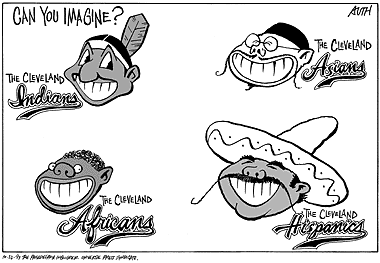
Here's a quick and dirty answer to this debate.  If the use of American Indians as institutional symbols is an honor bestowed upon a great people, and intended as such, why then not spread the honor to other groups? I have in mind something like this:


I, for one, would love a mascot of a puertorican jibaro wielding a knife (or a machete) on one hand and a cuatro on the other.


You don't have to agree with me on any of this in order to find the recent Helen Thomas controversy a bit off-putting.  According to Ms. Thomas, Israel should "get the hell out of Palestine," and Jews should "go home . . . to Poland and Germany."  After offering these remarks, Ms. Thomas soon apologized, and within a few days "retired."

This is hypocritical on many levels.  For my purposes here, I must ask: what makes these attacks on Helen Thomas' views a legitimate response to "hateful" forms of expression?  If we can retire Ms. Thomas on the basis of something she said, how else must we understand this response but as "political correctness" run amok?

Could American Indian mascots be next?

Sunday, October 16, 2011

Here they come again: the justices and affirmative action

Stop me if you have heard this one before: a student applies to an elite university and is denied admission.  Incidentally, admissions officials concede that they consider many different factors when making decisions, one of which is the race of the applicant.  The student who is denied admission then searches through the many applications only to discover that some Black and Latino applicants with lesser grades and/or test scores are granted admission to said university.  Alas, a federal case is born.

Abigail Fisher is only the latest in a long line of white applicants so aggrieved. It just so happens, however, that the U.S. Supreme Court might finally fall for the ruse once and for all.  Or in the words of Adam Liptak, "college diversity nears its last stand." 

This is ridiculous on too many levels. It is not terribly difficult to parse through the applicant pool and find admitted Black and Latino applicants who scored worse yet got in.  But it is also not terribly difficult to find in-state residents who scored worse than out-of-state residents yet got in, or mountain climbers, or sons and daughters of alumni, or applicants who can throw a football or hit a ball with a stick.  Somehow, we need an argument in order to differentiate the use of race from all these other factors.  But the justices -- or for that matter, critics of affirmative action -- have yet to offer one.

Here is what passes for a good argument nowadays, from anthropologist Peter Wood:
“The part of diversity that matters to me and a lot of academics is the intellectual diversity of the classroom. . . .  The pursuit of a genuine variety of opinions that are well thought through and well grounded is essential. But that has an off-and-on, hit-or-miss connection with ethnic and racial diversity.”
Here is another, from Yale law professor Peter H. Schuck: “The idea of racial and ethnic diversity altering the kind of conversation that goes on in the classroom is so overrated.” 

I happily concede either argument.  But note that similar things could be said about the use of any other factor considered by universities today, from the use of legacy or residency to extra points for doing extracurricular work or having elite athletic credentials.  
The point is this: the critics are make policy arguments, not constitutional ones.  So the issue here is whether the Constitution has anything to say about this question. If the Court's opinions are any indication, it appears that the answer is not as easy as one might think.

Here's what I would love to see in these opinions: a detailed analysis of the history of the 14th Amendment and the reasons why the Reconstruction Congress -- Bingham, Trumbull, and friends -- intended to bar the use of race by the state.  I think this is a tough argument to make, but I suppose it is possible.  Surely, I would expect Justice Thomas to at least pretend that such an argument exists.  Instead, all we get are silly and inane platitudes about the harmful effects of using racial factors.  

Hypocrisy is not becoming, much less by our resident philosopher kings.

Also, whatever happened to the norm of stare decisis?  I would expect the conservative justices to be particularly sensitive to this norm, and the notion that the public has a right to expect that the Court will not change its collective mind as the institution changes membership.  After all, remember the debate during the Kagan nomination about what makes a judge an activist.  The answer from the Republican leadership in the Senate, using the example of Justice Marshall, was that an activist judge is a judge that does not abide by established precedent.  They used the example of the death penalty and how Justice Marshall refused to accept these cases as settled law and instead continued to dissent in case after case. 

Could they really turn around this quickly and overturn Grutter, decided in 2003?

I still think that the case is still up for grabs.  The conventional wisdom is that the five conservative justices on the Court are prepared to take on Grutter.  Yet Justice Kennedy might not be quite so willing. His views on this question may be changing.  His recent concurring opinion in Parents Involved, for example, show a side of Justice Kennedy we had not seen before.  He even went as far as push back on the old conservative trope, Justice Harlan's dissent in Plessy. But to say that Justice Kennedy's views are evolving should not surprise anyone. Such is the lot of the super median.

In the end, he might ultimately save the Court from this embarrassment.